
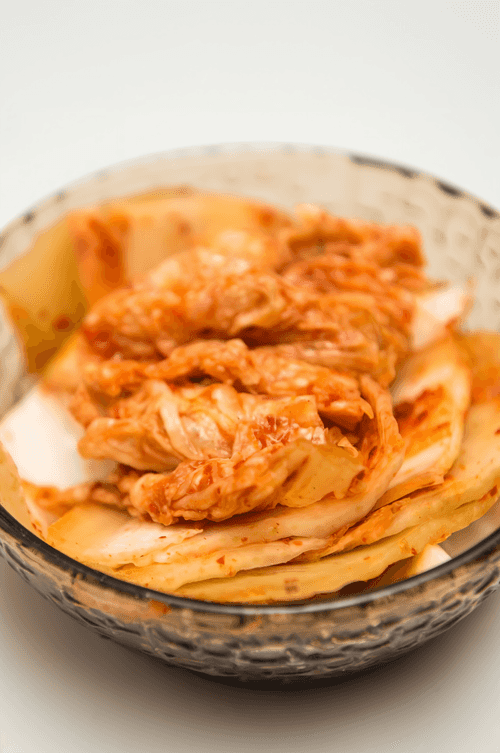
Kimchi (spicy Korean cabbage snack)
12 servings
120 minutes
Kimchi is the heart of Korean cuisine, a legendary dish with a millennia-old history. It originated as a way to preserve vegetables for long winters and has become a symbol of Korean hospitality over time. Spicy, flavorful, and crunchy, kimchi excites taste buds with its piquant heat and rich aroma of fermentation. Cabbage soaked in salt and spicy paste with hints of garlic, ginger, and fish sauce creates the perfect balance of flavors. Kimchi not only pairs excellently with rice and meat dishes but also serves as a base for many Korean soups and snacks. Besides its vibrant taste, it is rich in probiotics that strengthen gut health. This culinary masterpiece requires patience in preparation, but the wait is worth it: after fermentation, it reveals its depth and complexity.
1
The cabbage should be rinsed slightly, cut lengthwise into two parts, and the cores removed. Then dip it in water to allow water to get between the leaves for even salt distribution. Next, take coarse salt and distribute it evenly between the leaves. Tear off 3-4 large cabbage leaves and salt them as well; they will be needed later. Place the halves in a container, cover with water so they are fully submerged, and press down on top. Leave to brine for about 6-8 hours. After about 3 hours, the cabbage needs to be turned (swap the bottom halves with the top ones).
- Chinese cabbage: 3 kg
- Salt: 2 tablespoons
2
When the cabbage is salted, it should be thoroughly washed under running water, lightly squeezed, and placed in a colander for 30 minutes.
- Chinese cabbage: 3 kg
3
After washing the cabbage, you need to tear off a large leaf (from the middle of the half) and taste it for salt. Naturally, the meatier part of the leaf will be less salty than the end of the leaf. This way we will determine how well the cabbage is salted and how much salt to add to the dressing for a balanced salt level.
- Chinese cabbage: 3 kg
4
Now let's prepare the filling. First, we make a rice paste (starch solution). Dissolve two tablespoons of rice flour (chap salkaru) in 150 ml of cold water, boil the remaining water, and add the dissolved flour. Mix well to avoid lumps. It should turn into a paste, just like for wallpapering — originally, this paste is made from one tablespoon of high-starch rice (chap sal) and two cups of water, then boiled until a thick paste is obtained. It's quite a lengthy process, so it's better to make this paste in a simpler way as described above.
- Rice flour: 3 tablespoons
- Water: 300 ml
5
We cut the radish and pear into strips about 2.5 by 2.5 mm, chop the green onion to a length of 5 cm, and slice the onion very thinly into half rings. We lightly salt the radish and can drain the juice that comes out later.
- Daikon: 300 g
- Chinese Pears: 1 piece
- Green onions: 2 bunchs
- Onion: 1 head
- Salt: 2 tablespoons
6
Garlic and ginger need to be minced (can be done through a meat grinder), add the basic dressing, fish sauce, sugar, and starch. Mix well.
- Finely chopped garlic: 6 tablespoons
- Grated ginger root: 1 tablespoon
- Fish sauce: 100 ml
- Sugar: 1 tablespoon
- Rice flour: 3 tablespoons
7
Add the obtained mixture to the chopped vegetables and mix. Let it sit for about 30 minutes. Then taste the mixture for salt and recall how much salt is in the cabbage, adding salt if necessary.
- Salt: 2 tablespoons
8
We put on rubber gloves and generously coat each cabbage leaf with the mixture, then tightly fold the leaves back into a half-head, then take the longest leaf and carefully wrap it around and place it in a container. Once everything is arranged, take the leaves we prepared earlier and cover them on top.
- Chinese cabbage: 3 kg
9
Leave the container at room temperature for 24 hours (juice should be released), then place it in the refrigerator for three days. Before consumption, cut the kimchi into pieces 2.5 cm long.
- Chinese cabbage: 3 kg