


Perfect croissants
20 servings
300 minutes
The recipe was shared by Ruslan Polyakov, chef of the Remy Kitchen Bakery restaurant.

1
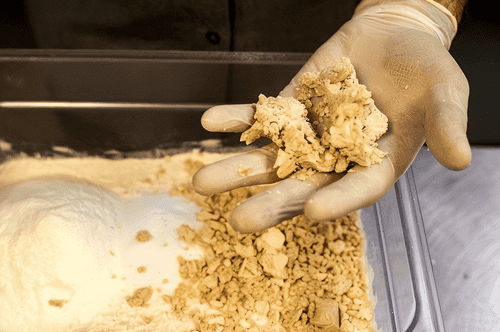
In the dough mixer or any other container, first add flour, dry milk, salt, and fresh yeast. Slightly crush the yeast in your hands to make it more crumbly. The ingredients can be mixed by hand or left as is; it doesn't matter.
- Wheat flour: 1 kg
- Dry milk: 30 g
- Salt: 18 g
- Fresh yeast: 35 g
2
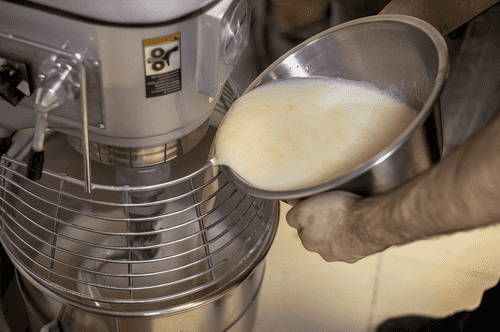
In a separate container, mix the egg, water, milk, and sugar. Whisk to break the yolk and pour into the dry ingredients in the mixer. Start kneading the dough. When all ingredients are visually mixed and the mass becomes somewhat homogeneous, add 40 grams of melted butter.
- Chicken egg: 2 pieces
- Water: 220 ml
- Milk 3.2%: 250 ml
- Sugar: 100 g
- Butter: 540 g
3
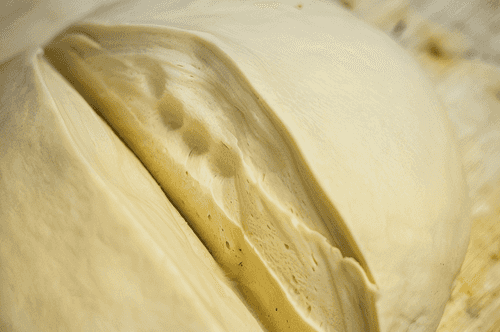
Continue kneading until the dough turns into a smooth mass without lumps that doesn't stick to the walls. If you cut a piece of dough, there will be small bubbles inside.
4
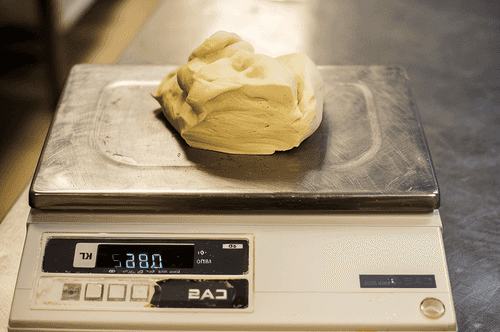
Divide the dough into two equal parts, wrap each portion in plastic wrap, and leave at room temperature for 1 hour.
5
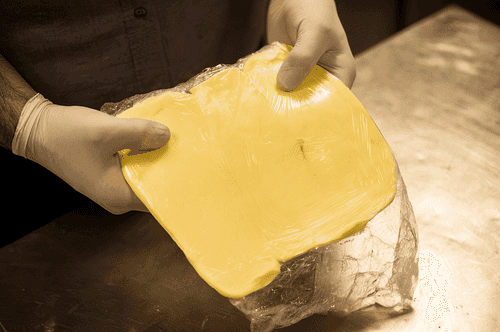
Divide the softened butter into two equal parts of 250 grams each. Wrap them in plastic wrap and roll out to a thickness of 5 mm. Place the rolled butter in the freezer to firm up into a cohesive elastic layer.
- Butter: 540 g
6
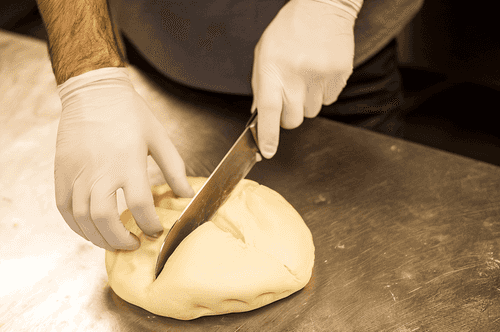
After 1 hour, you can start the first rolling of the dough. The dough can be rolled in two ways. The first is to stretch the dough by hand and roll it a bit with a rolling pin. The second is to cut the round piece of dough crosswise like this.
7
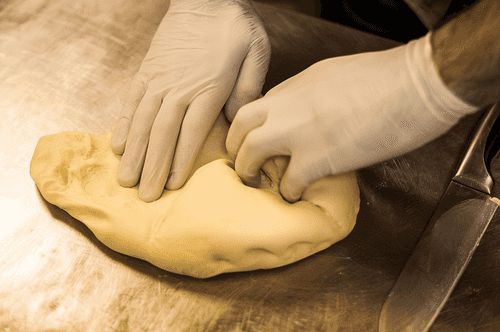
Then you need to turn the corners of the dough outward - it will form a square.
8
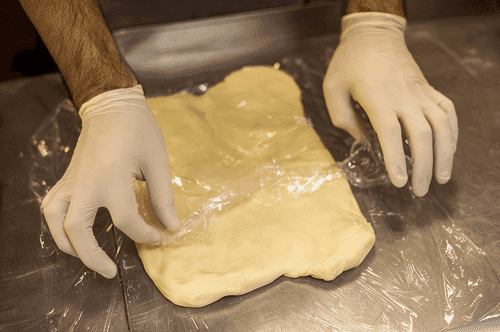
Stretch it with your hands, wrap it in film, and put it in the freezer for 5 minutes to cool slightly.
9
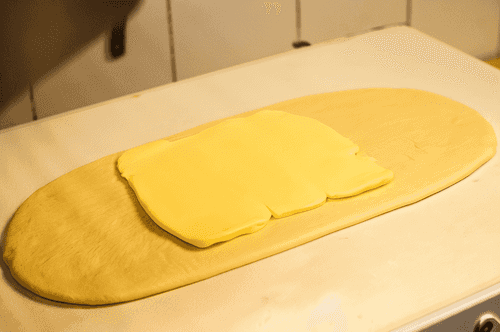
Roll out the chilled dough into a rectangle 1 cm thick. Place a piece of butter in the center.
- Butter: 540 g
10
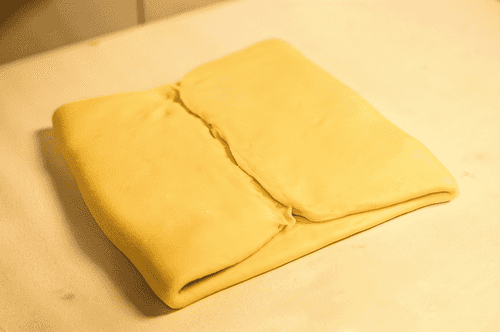
Wrap the butter in the dough like an envelope. Pinch the edges and cut off any excess dough (that extends beyond the butter layer). This gives us a dough consisting of two layers separated by a layer of butter. Wrap it in plastic wrap and send it to the freezer for 30 minutes. This is necessary for the temperatures of the butter and dough to equalize and become one.
- Butter: 540 g
11
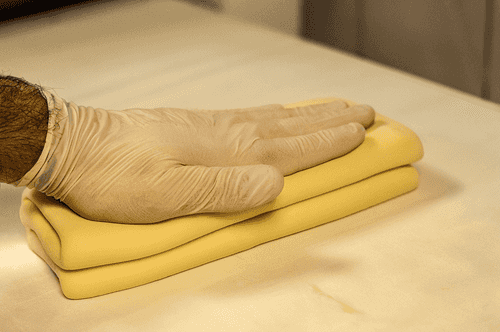
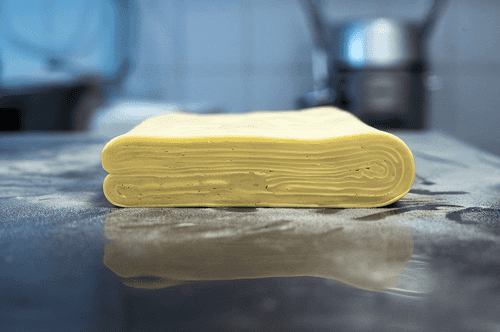
After 30 minutes, take the dough out and roll it into a sheet 11 mm thick. Now fold it like a book to create 8 layers of dough. To do this, fold the edges of the dough from each side to the middle. Then fold the dough in half again (resulting in 4 layers plus another 4 — so a total of 8). Wrap the dough in plastic wrap and put it back in the freezer for another 30 minutes. Then take the dough out again and roll it into a sheet 11 mm thick. Fold it like a book again, wrap it in plastic wrap, and place it in the freezer for another 30 minutes. The dough will now have 32 layers.
12
Take out the dough again, repeat the procedure, and send the wrapped dough back to the freezer for 30 minutes. The dough is ready. It can be frozen and used within 2 days. The finished dough has 128 layers, not counting the butter (these are the light layers). The number of layers affects the airiness of the croissants. More layers mean more holes — pores.
13
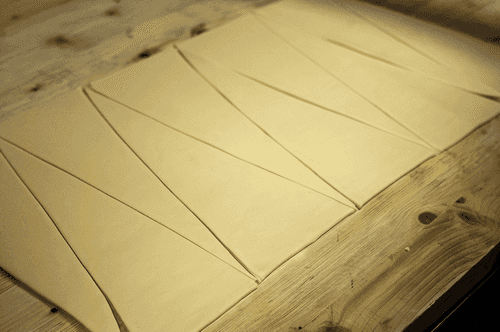
Roll out the dough into a rectangle approximately 60 by 35 cm and 6 mm thick. Then cut the dough into triangles.
14
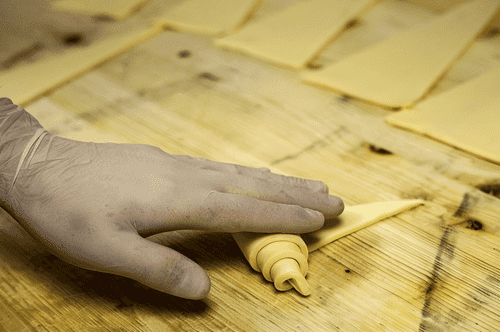
Roll each triangle into a roll, starting from the thick edge.
15
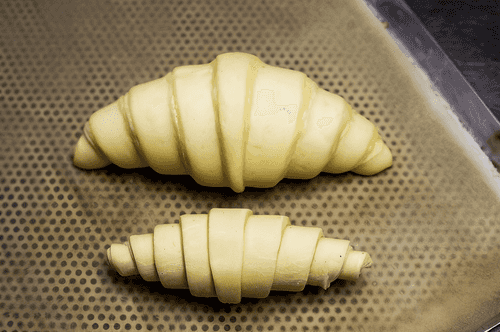
Croissants can be frozen again (and baked within the same 2 days) — or sent for proofing immediately to bake right away. To simulate a proofing cabinet at home, place a pot of water in the oven, lay the croissants on a tray and put them in the oven for 2 hours. There's no need to turn on the oven; the environment will be warm and humid enough as is. The second option is to leave the croissants covered with plastic wrap at room temperature for 5 hours. Proofing is necessary to activate the yeast's work. After a certain time, the longer croissants proof, the more bubbles they will have and the smaller they will become. The dough after proofing is very delicate. If you gently shake the tray with croissants, they will start to jiggle slightly like jelly. And if you lightly press on a croissant with your finger, you can feel tiny bubbles bursting inside it. This means that proofing was successful. During proofing, croissants grow by 2.5 times.
16
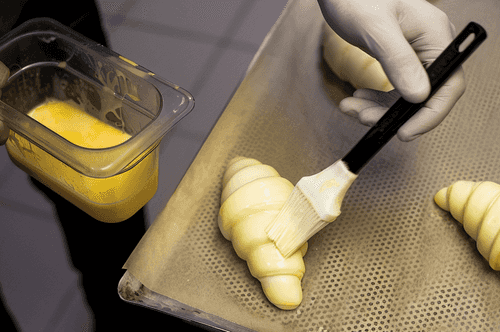
Before baking, brush the croissants with a mixture of egg and water (20 ml of water per 1 egg), as it is easier to brush than with pure egg. Brush the croissants very carefully, lightly with a brush, and only along the twisting lines, not across; otherwise, the structure of the croissant will be disrupted and the layers will slide relative to each other.
- Chicken egg: 2 pieces
- Water: 220 ml
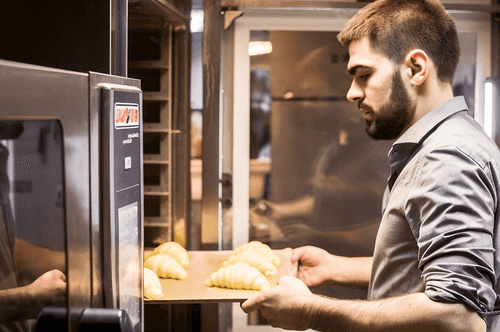
17
The oven needs to be preheated to 190 degrees. When the oven is opened, the temperature will drop, and it needs to be adjusted to 180 degrees. This is done so that the croissants immediately reach their required temperature.
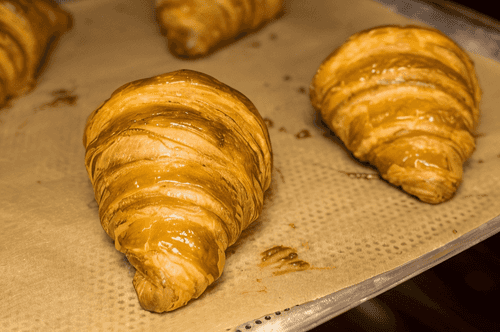
18
Bake croissants for about 10 minutes at 180 degrees, then another 10 minutes at 160 degrees. The first 10 minutes is an estimate; it depends on the specific oven's parameters. The signal to switch the temperature is when the croissant looks ready on the outside. In reality, it's only ready in appearance and raw inside, so you need to change the temperature setting to finish cooking it. Then remove the croissants and let them cool: during this time they will continue to cook like all hot items. Freshly baked croissants last for 6 hours; after that, they are not as tasty.