


Ossetian pies
8 servings
120 minutes
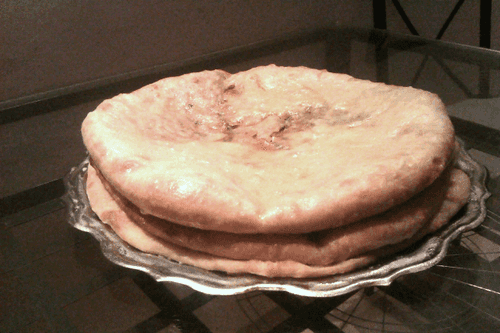
Ossetian pies are a traditional dish of Ossetian cuisine that symbolizes hospitality and family values. The roots of these pies go deep into the history of Ossetia, where each housewife passed down recipes from generation to generation. Their dough is soft and airy, while the filling is generous and rich in flavors. Variations of the filling include cabbage, potato with cheese, greens, and even beet tops. These pies are perfect for festive gatherings or cozy family dinners. They are served hot, brushed with butter, giving them an appetizing shine and tenderness. Ossetian pies are not just food but a part of cultural heritage that brings people together at one table.
1
In a glass (about 200-250 grams) of warm water, mix yeast and sugar, and let it sit until foam appears on top (5-10 minutes).
- Dry yeast: 1 teaspoon
- Sugar: 1.5 teaspoon
- Water: 2 glasss
2
Sift the flour into a deep bowl (about 400 grams).
- Wheat flour: 2 glasss
3
Make a well in the flour, pour in a cup of water with yeast and a cup of warm water, add salt and vegetable oil.
- Water: 2 glasss
- Salt: 1 tablespoon
- Vegetable oil: 5 tablespoon
4
Knead the dough and place it in a warm place (for 20-25 minutes).
5
Cabbage filling (for one pie). Shred the cabbage (the amount can vary; it's considered enough when the filling can be gathered in hand to form a ball of 10-12 cm in diameter), fry in vegetable oil with khmeli-suneli (about 1/3 teaspoon), add salt to taste.
- White cabbage: 200 g
- Vegetable oil: 5 tablespoon
- Khmeli-suneli: pinch
6
Filling with potatoes (for one pie). Boil 4 medium potatoes until ready, mash them, add 100 grams of Adyghe cheese, and salt to taste. You can add a little milk (about 4-5 tablespoons) for a softer consistency. Sometimes I add finely chopped, fried mushrooms with onions, but that's a matter of 'taste and color'.
- Potato: 3 pieces
- Adyghe cheese: 350 g
- Milk: to taste
7
Filling with cheese (for one pie). Mash Adyghe cheese, add salt to taste, and a little milk for a soft consistency.
- Adyghe cheese: 350 g
- Milk: to taste
8
Filling with beet greens (for one pie). Chop the greens (any you like: dill, parsley, green onion, cilantro, etc.), add about 200 grams of Adyghe cheese and salt to taste.
- Beet tops: 2 bunchs
- Green: 1 bunch
- Adyghe cheese: 350 g
9
We take out the dough, it is quite liquid; if placed on a plate, it will spread. We grease our hands with sunflower oil (to prevent sticking) and visually divide it into 3 parts.
- Vegetable oil: 5 tablespoon
10
Ideally, have 2 large plates for easier kneading of the dough with filling. Cover the plates with flour, place the dough for one pie, knead a bit with flour to firm the consistency. Flour should be sprinkled on all surfaces you work with to prevent the dough from sticking and leaving half of the filling on the plate.
- Wheat flour: 2 glasss
11
We create a circle with a diameter of 20–25 cm by hand, place a filling ball in the center and wrap the edges to make it look like a large dumpling. We sprinkle flour on top and start kneading the filling with our fist and palms from the center to create a flatbread about 40 cm in diameter. It is better to flip the resulting pancake using a second plate during the process (i.e., cover the first plate with the second one, hold both by the edges and flip so that the flatbread moves to the other plate in an inverted form).
- Wheat flour: 2 glasss
12
We take a baking tray (I use a special pizza tray with holes, but a regular one works too, no difference), sprinkle it with flour, place the flatbread (using the same principle as with two plates), and make a small hole in the center for steam to escape.
- Wheat flour: 2 glasss
13
Place in the oven at 240–260 degrees for 10 minutes on the lower level, then 10 minutes on the upper level. The pie will look white with slightly browned edges.
14
Take out of the oven and generously brush with butter.
- Vegetable oil: 5 tablespoon