
Easter cake with fresh yeast and sour cream
12 servings
210 minutes
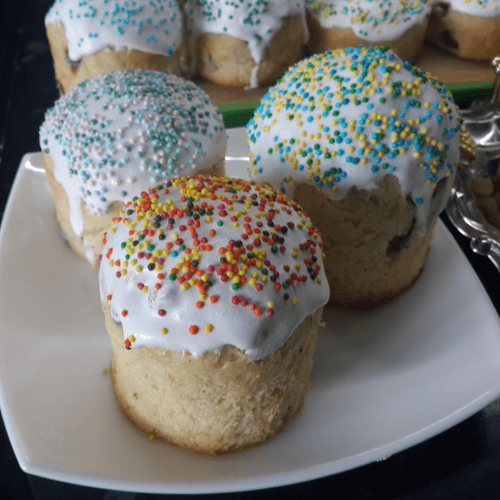
This recipe is so detailed, especially for young housewives, young wives who have never worked with yeast dough before, but decided to please their young husbands and loved ones with delicious aromatic pastries for the holidays. This amount of ingredients is enough for 16-20 Easter cakes with a diameter of 7-8 cm and a height of 8-10 cm, but in the photo are very tiny Easter cakes, which I baked this year specifically so that they do not need to be cut at all and can be given to children whole. But if you have very good yeast, you can get more. Good luck! Be sure to cook Easter cakes in a good mood!
1
Take all ingredients out of the fridge in advance, say an hour to an hour and a half before use, so they reach room temperature and the butter becomes soft but not melted. Rinse the raisins immediately, sort them out and soak them in hot water to swell. It is preferable for the room to be warm and draft-free.
- Butter: 150 g
- Seedless raisins: 200 g
2
We tuned into good thoughts, imagined how we would treat our loved ones with our delicious kulich, and with bright thoughts, we began preparing the dough. We take a large pot or bowl of about 4-5 liters, where we will knead the dough (choose one with a rounded bottom if possible for convenience), and pour in warmed milk with one teaspoon of sugar (dipping a very clean finger into the milk, we remove it from the heat as soon as we feel warmth). We add fresh yeast, which has already warmed to room temperature, into the milk and crush the yeast in the milk with our hand, dissolving it. Granules no larger than a wheat grain are acceptable — they will dissolve very quickly. We cover it with a clean cotton cloth and place it in a warm place for half an hour.
- Milk: 300 ml
- Sugar: 200 g
- Fresh yeast: 50 g
3
While the dough rises, you can sift flour into a large bowl with a clear mind and conscience. The amount of flour needed may vary depending on its quality, so it's better to sift more.
- Wheat flour: 900 g
4
Remove the raisins from the water and squeeze out the excess moisture with your hands — it can interfere with the rising of the kulich. Place on a clean napkin and leave until use.
- Seedless raisins: 200 g
5
After about 20 minutes of letting our dough rise, we can prepare the eggs with sugar. We use 2 whole eggs and 3 yolks (leaving 3 whites for the glaze) and all the sugar, adding vanilla sugar as well. We whisk the eggs with sugar thoroughly until smooth.
- Chicken egg: 5 piece
- Chicken egg: 5 piece
- Sugar: 200 g
- Vanilla sugar: 3 teaspoons
6
30 minutes have passed — here our dough has risen! It has doubled in size and has a dome on top. Now we carefully mix in the eggs with sugar (making sure they are not cold), using only our hands, without spoons or spatulas.
- Chicken egg: 5 piece
- Chicken egg: 5 piece
- Sugar: 200 g
- Vanilla sugar: 3 teaspoons
7
We press the softened butter in our hand and gradually add it to the dough with eggs, mixing carefully but thoroughly and kneading the pieces and lumps until uniform.
- Butter: 150 g
8
We add sour cream and gently mix the future dough by hand again.
- Sour cream 20%: 250 g
9
We gradually add flour and start kneading the dough by hand directly in the bowl. At first, it's easy, but the more flour we add, the harder it becomes to pull our hand out of the dough. When it starts to get heavy, it's time to add raisins. We sprinkle them into the dough; we might not need to use all of them depending on the situation. At this point, the dough should be thick enough not to spread.
- Wheat flour: 900 g
- Seedless raisins: 200 g
10
We continue to knead the dough, adding a handful of flour. We knead it gently, carefully, with love. We lift it with our palms from the edge of the bowl, fold it inward, and gently press it with our fists (but no aggression!). Then it starts to come off our hands. We knead a little more, then moisten our hand with odorless vegetable oil, smooth the oily hand over the surface of the dough, and continue kneading, sometimes moistening our hand with oil. When the dough no longer sticks to our hands, we leave it in a warm place for another half hour, covering it with a napkin.
- Wheat flour: 900 g
- Vegetable oil: to taste
11
While there is time, we can wash the dirty dishes and prepare the workspace for further creativity.
12
After half an hour, we mix the dough again without adding anything. We gently and carefully knead the dough in the bowl with our hands, knead a little, and let it rise again for about half an hour.
13
During these 30 minutes, we prepare the molds by greasing them with vegetable oil and whip the 'gogol-mogol' — mixing a cup of powdered sugar with 3 egg whites using a mixer, but not on the surface where the dough is to avoid disturbing it. We whip the 'gogol-mogol' until thick. To check readiness, we drop some glaze on a spoon — if it hardens after 5 minutes, everything is good.
- Powdered sugar: 1 glass
- Chicken egg: 5 piece
14
30 minutes have passed after the second kneading of the dough, and we turn on the oven to 100 degrees. We grease the work surface with vegetable oil and start filling the molds. We carefully separate pieces of dough, about 1/3-1/2 the size of the molds, and place them on the oiled table. We cover them loosely with our palm as a 'dome' or with both hands depending on the size of the molds, and with circular movements, we form balls, trying to 'roll' the protruding raisins inside. We place the formed ball in the mold and repeat until all molds that fit on the oven rack are filled. We leave them to rise for about 10 minutes, then place them on the middle rack in the oven.
- Vegetable oil: to taste
15
For the next 10 minutes, we will fantasize about decorating the Easter cakes and examine our sprinkles. Then we increase the oven temperature to 180 degrees and bake the cakes until ready. If there is still dough left, we form the next batch of cakes in the same order. When the cakes rise and brown in the oven, we can check their readiness using a grandmother's method that never fails: we put on kitchen mittens, take one cake (the tallest), place it on our palm in the mitten with our elbow close to our body and hand horizontal, then lightly clap with the other hand on the inside of our elbow - if the cake jumps up from the mitten, it means it's definitely ready.
16
Took the kulich out of the oven and placed them on their side on a flat surface to prevent them from collapsing. Reduced the temperature back to 100 degrees and bake the second batch, if available, using the same method.
17
We coat the warm kulich with glaze and immediately decorate it so that the crumbs – caramel sticks to the glaze.
- Powdered sugar: 1 glass