


Red Velvet Cake by Andy Chef
6 servings
120 minutes
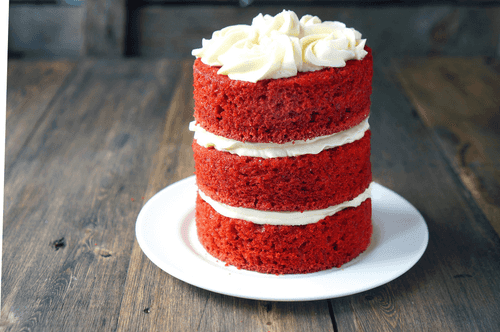
Red Velvet Cake is a legendary dessert that has won the hearts of gourmets with its velvety texture and rich flavor. Its history began in the USA, where it became popular due to its unusual red hue, traditionally achieved through the reaction of cocoa and acidic ingredients. This signature recipe by Andy Chef features airy layers with light chocolate notes, complemented by a creamy frosting with a delicate texture. Preparation requires precision in proportions and patience, but the result is worth all the effort. The cake is perfect for festive occasions, impressing with its vibrant color and harmony of flavors. Its softness and moderate sweetness pair well with a cup of freshly brewed coffee or fragrant tea, leaving a delightful aftertaste.
1
The dough is so simple that there are no criteria for when to add the ingredients. I didn't even turn on the mixer until I added the final ingredient. In a bowl, mix flour (340 g), sugar (300 g), 1 tablespoon of cocoa, 1/4 teaspoon of salt, 1 teaspoon of baking soda, and 2 teaspoons of baking powder.
- Wheat flour: 340 g
- Sugar: 300 g
- Cocoa powder: 1 tablespoon
- Salt: 0.3 teaspoon
- Soda: 1 teaspoon
- Baking powder: 2 teaspoons
2
Three eggs, odorless vegetable oil (300 g).
- Chicken egg: 3 pieces
- Deodorized refined vegetable oil: 300 ml
3
At the end, add 280 g of buttermilk. I replaced it with 150 g of 33% heavy cream and 130 g of 20% sour cream; you can just use a fattier kefir. And red food coloring.
- Cream 35%: 150 ml
- Sour cream 20%: 150 g
- Red food coloring: 2 teaspoons
4
I used about 1.5-2 tsp of gel food coloring for this amount of dough. Don't hold back here; the dough should be nuclear red. Mix everything well with a mixer.
- Red food coloring: 2 teaspoons
5
The dough will be quite liquid, don't be scared, that's how it should be. Leave it for 10-20 minutes, as the baking soda needs some time to react with the dairy ingredient.
6
Grease the mold with butter and line the bottom with parchment. Pour in the required amount of batter. I made three layers of 16 cm each, or you can do two layers of 18 cm. To be truly professional, first weigh the empty bowl and then the bowl with the prepared batter. Through mathematical calculations, you'll understand how much batter to pour into the mold for each layer.
7
Bake at 170 degrees for 20 minutes. Pay attention. I started checking with a skewer at the 15th minute. As soon as it came out dry, I took the pan out. Let the cake cool in the pan for about 2 minutes, then carefully transfer it to a rack.
8
Cool the mold (I just rinse it with cold water), grease it with oil again, place parchment at the bottom and go ahead. When the layers cool down, wrap each in film and put them in the refrigerator for 2 hours.
9
After two hours, take out the cakes and carefully cut off the top — it will likely rise a bit in the center. Check how porous the cake is. And how delicious it is. Next, you can spread cream on the cakes and assemble the cake. I'll show you how I did it.
10
To make the cake look nice, you need to trim the edges (they brown in the oven). You can simply cut a thin layer with a knife, but I used a metal ring — the only way to get all layers the same shape and size.
11
Repeat the same with the other layers. I repeat, if you cover it with cream on the outside, do not cut the sides, no one will appreciate it anyway.
12
I used creamy frosting, which you are well familiar with. It will be successful to pipe roses on top - a mix of red brutality and white tenderness.
13
If you followed my path, prepare deep creamers or wide glasses. Tear the cake scraps into small pieces of 2-3 cm by hand, layer these pieces, add cream on top, and continue until the top. This is a great way to utilize all scraps (not just in this recipe). The taste will be the same, but there will be two desserts.
14
By the number of layers (2-4 layers from 1.5 to 2.5 cm):
15
Form diameter (cm) 16-18 20-22 24+ dough portions 1 2 3
16
Cream: cream cheese — 340 g. Butter — 115 g. Powdered sugar — 100 g. Vanilla extract — 2 tsp.
17
This cream is very simple — you don't need any skills or complicated preparation steps, everything is easy. And here is the most important and only rule — very cold cream cheese, very soft butter.
18
That is, cheese should be kept in the fridge all night to be cold and firm enough. On the contrary, butter should be left on the kitchen table for a couple of hours (overnight) to become soft and pliable. Only under these conditions will you get an excellent cream with a delicate texture and flavor. The process is very simple — just combine the ingredients in a bowl and mix with a mixer until smooth. This will take about 5-7 minutes.
19
Such cream is certainly better kept in the fridge; in a pastry bag, it can easily last for 5 days without losing texture and properties. But don't think it's too delicate — powdered sugar and cream cheese give it enough stability. So even at room temperature (around 17 degrees), the cake can easily last several days without losing its shape.
20
Here is another property — they can cover the sides and top of the cake, the cream doesn't 'slide' and retains its shape. This property is convenient when making caps for cupcakes or various 'flowers' for decorating pastries.
21
Here’s a tip that many ask about. If the powder squeaks or you need a whiter color, first whip the oil and powder with a mixer on maximum for 5-10 minutes. Then add the cheese.
22
During the mixing stage, you can flavor the cream by adding cocoa or fruit purees. Here’s an example of raspberry cream. Make a puree from raspberries (it doesn't matter if they are frozen or fresh). Now add a couple of spoons of the puree to the cream and mix. You can strain the puree to remove the seeds, but I didn't. If you mix the cream for a minute, it will become marbled with white and pink swirls. Mix for another 2-3 minutes for a uniform pink cream.
23
There are also many questions about cottage cheese. First of all, do not confuse cream cheese and cottage cheese — the former resembles processed cheese, while the latter is more like finely ground curd. If you taste it from the package, it will be slightly salty; don't be alarmed — salt enhances sweet ingredients and slightly tones them down (to prevent the cream from becoming cloying). For my desserts, I use Hochland, less often Almette. You can even use soft ricotta or other cheeses like mascarpone and Philadelphia — but the basic recipe will still be as I wrote above.
24
Here is a small guide to help you; I give portions based on my experience, you may need more or less cream depending on the thickness of the layers. Form diameter (cm) 16-18 20-22 24+ naked cake (servings) 1 1.5 1.5 regular cake (servings) 2 3 4