





Kiwi Croissants
5 servings
300 minutes
Kiwi croissants are an original combination of delicate puff pastry and juicy exotic fruit. Born in France, the croissant became a symbol of morning treats, but this variation adds a fresh, fruity touch to the traditional flavor. The crispy golden crust melts in your mouth, while the soft layers are infused with a creamy aroma. Kiwi adds a slight tang and refreshing sweetness, creating a harmonious balance with the buttery dough. This dessert is perfect for morning coffee or afternoon tea. Kiwi croissants are not just pastries; they are an art that combines French traditions with bold flavor experiments.
1
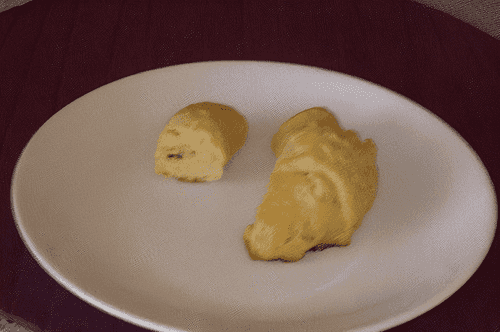
Puff yeast dough for croissants: dissolve 7 g of dry yeast (or according to the ratio on the dry yeast package, depending on the amount of flour) in half of the required warm cream (milk can be used). Add sugar and 100 g of flour. Mix, cover, and place in a warm place until the dough rises.
- Dry yeast: 7 g
- Cream 10%: 0.5 glass
- Sugar: 1 tablespoon
- Wheat flour: 400 g
2
When the dough rises, add the remaining cream, 150 g of flour, knead the dough, shape it into a small rectangle, cover it, and place it in the refrigerator for about 2 hours.
- Cream 10%: 0.5 glass
- Wheat flour: 400 g
3
Pour 150 g of flour into a separate container; the flour will be needed for dusting the dough while rolling (more flour may be needed as well).
- Wheat flour: 400 g
4
Sprinkle the board where we will roll out the dough generously with flour, and also dust the rolling pin with flour. Take the dough out of the fridge and place it on the board. Dust all the dough with flour. Roll the dough into a rectangle about 25 cm wide and 30 cm long. The dough will be difficult to roll. To avoid damaging the dough's structure, roll it out carefully.
- Wheat flour: 400 g
5
Take 130 g of butter out of the fridge (the butter should not be softened), place it between two pieces of plastic wrap, and roll it into a rectangle with a rolling pin or shape it by hand. The butter layer should match the width of the dough (about 25 cm) in height and be shorter in length (about 10 cm).
- Butter: 180 g
6
Sprinkle the dough with flour. Place a layer of butter on the floured dough. Close the dough by folding all edges towards the center: first the length edges, then the width edges. Dust the dough and rolling pin with flour. Carefully roll out the dough to a rectangle approximately 30 cm long and 25 cm wide. As you roll, the butter will 'leak' from the dough, so when it starts to 'leak', immediately sprinkle flour on both sides of the dough, doing this every time the butter 'leaks' out, and roll it out step by step to the desired size. If the butter 'leaks' from the edges of the dough, remove the excess butter with your hand or a knife along the edge of the dough. To avoid disrupting the dough's structure, once rolled to the desired size, sprinkle it with flour and place it in the refrigerator for about 20 minutes.
- Wheat flour: 400 g
7
We take the dough out of the refrigerator. We sprinkle it with flour. We close the dough again by folding its edges to the center: first lengthwise, then widthwise. We roll out the dough, sprinkling flour on both sides each time when the butter starts to 'come out' of the dough. If butter comes out from the edges of the dough, remove the excess with your hand or a knife along the edge of the dough. To avoid disrupting the structure of the dough, as soon as we roll it to the required size (about 30 cm long and 25 cm wide), we stop rolling it out. To ensure that the rectangle has straight (clear) edges, we shape them with our hands or trim them with a knife.
- Wheat flour: 400 g
8
Beat 4 eggs. Melt 50 g of butter (you may need a little more).
- Chicken egg: 4 pieces
- Butter: 180 g
9
First, brush the dough with beaten egg, then with butter; remove excess egg and butter by 'brushing off' with hand or brush; the dough should be just coated without any 'liquid' on it. Cut the dough into triangles: large ones along the length of the dough or small ones by cutting the dough in half lengthwise and then cutting triangles from each half. Large triangles will be easier to roll into croissants. Cut carefully to avoid damaging the dough and layers separating. Gently flip the triangles and brush the uncoated side of each triangle with beaten egg and then melted butter.
- Chicken egg: 4 pieces
- Butter: 180 g
10
We peel the kiwi and cut it into thin and narrow strips. We place one strip of kiwi on each croissant. We carefully roll the croissants from the base of the triangle to its tip, so the dough doesn't tear. We press them a little with our hands and place them on the baking sheet with the tip down, so they don't open while baking. We brush all the croissants again with melted butter before placing them in the oven preheated to 180 degrees for 15 minutes.
- Kiwi: 1 piece
- Butter: 180 g