










Scallop adductor muscle
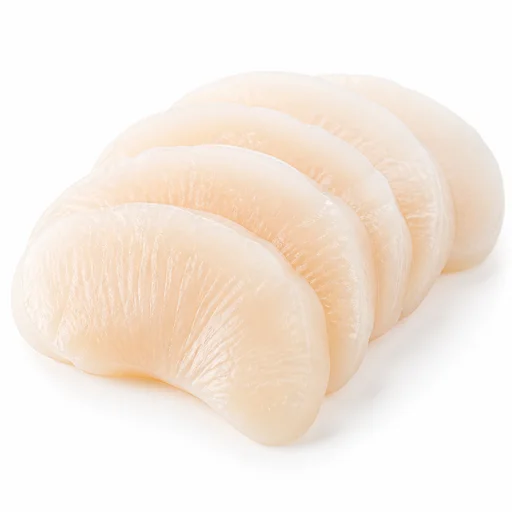
The large white cylindrical shell-closing muscle of the scallop, firm and juicy, with a clean sweetish marine taste, almost raw in carpaccio and as sashimi, seared to a crust.
Scallop adductor muscle is the large white cylindrical shell-closing muscle of the sea scallop, its most prized part, firm, springy, juicy, with a clean sweetish marine taste and a tender, slightly fibrous texture. It is eaten almost raw in carpaccio, tartare, ceviche and as sashimi, quickly seared to a caramel crust, grilled, steamed and put into pasta, risotto and soups.
Calories, proteins, fats and carbohydrates per 100 g of product
Scallop adductor muscle, Raw: Calories 69.0 kcal, Proteins 12.1 grams, Fats 0.5 grams, Carbohydrates 3.2 grams per 100 g of product.
Scallop adductor muscle, Steamed: Calories 111.0 kcal, Proteins 20.5 grams, Fats 0.8 grams, Carbohydrates 5.4 grams per 100 g of product.
Scallop adductor muscle, Fried: Calories 216.0 kcal, Proteins 18.1 grams, Fats 10.9 grams, Carbohydrates 10.1 grams per 100 g of product.
Recipes with this ingredient

The recipe is taken from the book "Salads, fish and seafood appetizers.
7
2
75